
Nigeria Tax
How to Legally Split Income to Stay Within Tax Thresholds in Nigeria
A careful 2026 guide to lawful income structuring in Nigeria, focused on substance, documentation, small-business thresholds, and the line between defensible planning and artificial allocation.
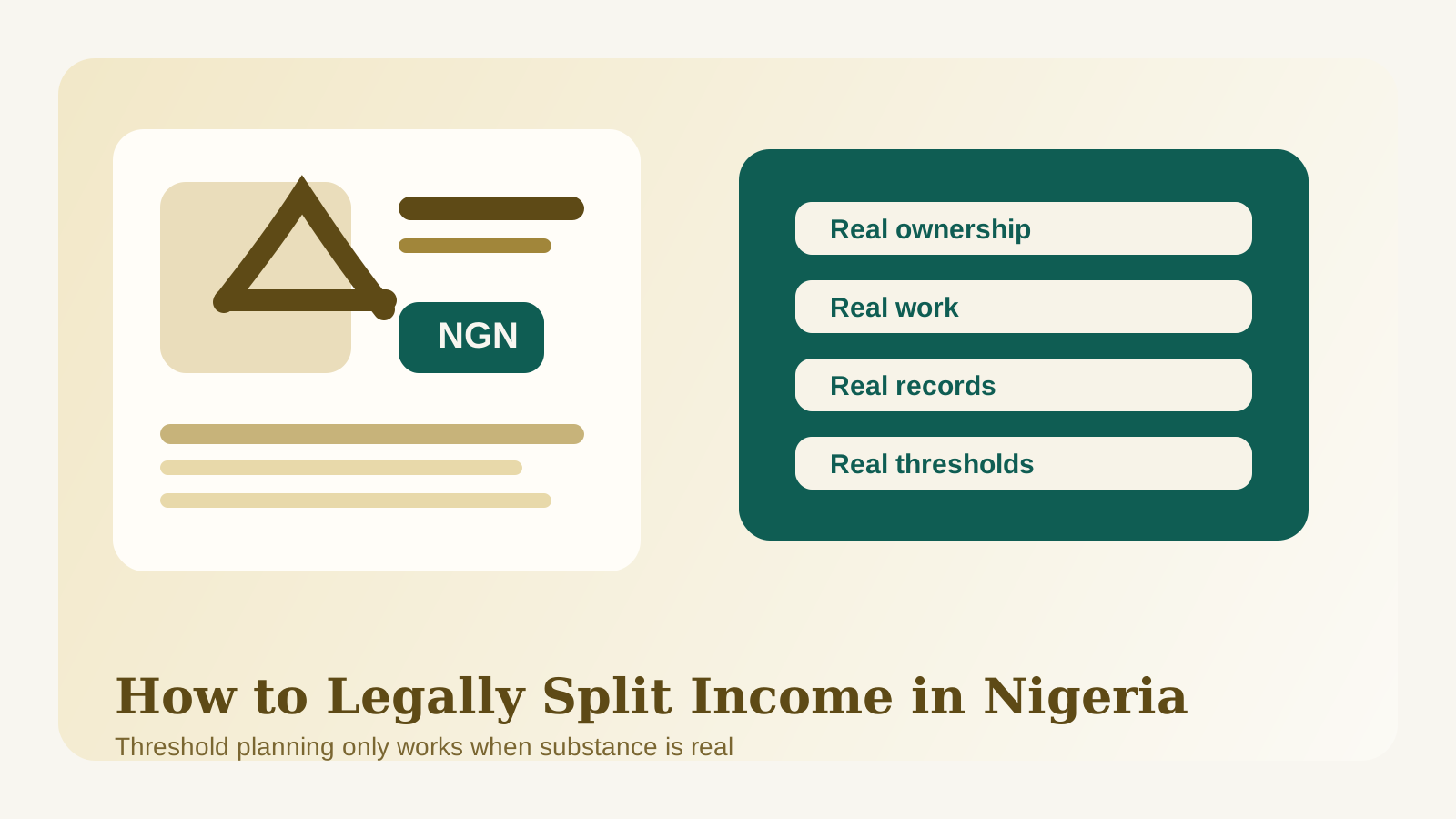
This topic attracts bad advice because the phrase "split income" sounds simple while the legal reality is not.
Some people hear it and think of a harmless planning step. Others hear it and imagine an obvious audit problem. Both instincts can be right depending on what the taxpayer is actually doing.
The clean version of income splitting is not fake allocation. It is lawful structuring where the person or entity that earns the income, controls the work, bears the risk, and owns the commercial arrangement is the one that reports it. The unsafe version is moving profits on paper after the fact just to push tax down.
That distinction matters more in 2026 because Nigeria's reform direction is more documentation-heavy, more digital, and less tolerant of artificial transactions.
Start with the real question
The useful question is not, "How can I divide money so I pay less tax?"
The useful question is this:
Which person or entity is genuinely earning each income stream, and can that position survive review?
If the answer is weak, the structure is weak.
PwC's Nigeria 2025 reform summary says the current framework increases documentation demands, strengthens anti-avoidance rules, and gives authorities broader power to recharacterise artificial transactions. That means arrangements that look clever on a spreadsheet but have no commercial substance are exactly the ones that become fragile.
Why thresholds matter, but not by themselves
Threshold planning is still real. The same PwC summary says that small companies are now described as those with annual turnover of NGN 50 million and below, with total fixed assets not exceeding NGN 250 million, and that those small companies can benefit from relief on corporate income tax, development levy, and withholding tax in the circumstances outlined.
So yes, thresholds matter.
But this does not mean you can just slice one business into several names with no operational difference and expect the law to respect it. A threshold is useful only when the underlying structure is commercially real.
That means asking:
- who owns the client relationship?
- who signs the contract?
- who delivers the work?
- who controls the bank account?
- who bears refund risk, staffing cost, and delivery failure?
If the answers all point to one person while the invoices are being scattered elsewhere, the planning story becomes weak.
What legal income splitting can look like
There are defensible patterns.
1. Separate people doing separate work
If a husband and wife each carry out real work, each has clients or assigned responsibilities, and each is paid on terms that match the commercial reality, the income can be split because the work is actually split.
That is not a trick. It is just accurate reporting.
2. Market-rate compensation inside a real business
If a family business employs relatives who actually work in the business and who are paid at a defensible market rate, that can be lawful. The records must show:
- role
- work performed
- pay basis
- payroll trail
- evidence that the remuneration was not invented after profit was known
3. Separate business lines with separate control
One person may run consulting. Another may own a distinct training line or digital product line. If those activities are genuinely separate and the records support the split, different taxpayers can report different income streams without strain.
4. Company versus individual structuring
Sometimes the lawful question is not whether to split income between people, but whether some income should arise through a properly structured company rather than stay at individual level. That has to be built around real contracts, bank flows, bookkeeping, and filing obligations.
If you need the structure angle first, read Best Business Structures for Nigerians Earning in USD/GBP.
What illegal or unsafe splitting usually looks like
The weak patterns are easier to spot than people think.
1. Invoices moved after the money is earned
If one person did the work, one account received the money, and the taxpayer later "allocates" part of the profit to another person with no pre-existing commercial basis, that looks artificial immediately.
2. Spouse allocations with no real role
Putting income into a spouse's name is not planning if the spouse performed no real function, bore no risk, and had no control over the activity.
3. Multiple entities with one real business
If the same staff, same customers, same account control, same management, and same delivery process all sit under one practical business, dividing billing across multiple names only to stay under thresholds can be challenged as artificial.
4. Payments with no paper trail
A structure is not saved by good intentions if there are no:
- contracts
- payroll records
- board decisions
- timesheets
- invoices
- transfer explanations
In 2026 that weakness is more dangerous because Nigeria's compliance environment is moving toward more real-time transaction visibility.
Why e-invoicing changes the tone of this issue
The FIRS notice introducing the national e-invoicing regime for large taxpayers states that the system is meant to improve transparency, efficiency, and real-time visibility into business transactions. The ATRS platform itself describes tax reporting in near real-time terms.
Even where a smaller taxpayer is not yet under the exact same operational burden, the direction of travel is obvious: transaction evidence is becoming more central, not less.
That matters for income splitting because artificial arrangements tend to break when transaction-level data, invoice identity, and bank behavior are compared.
A practical test before you split anything
Run this five-point test.
1. Substance test
Would an independent reviewer agree that each recipient really earned the amount allocated?
2. Control test
Who actually controls the customer, work product, and payment instructions?
3. Documentation test
Would the file show contracts, invoices, payroll, approvals, and bank flows that match the story?
4. Conduct test
Did the parties behave consistently all year, or was the split invented after year-end?
5. Threshold obsession test
If the arrangement makes sense only because of the threshold and makes no commercial sense without it, that is a warning sign.
What I would document in a real family business
If a Nigerian family business wanted to structure income lawfully, I would insist on these basics:
- clear ownership records
- role descriptions for working family members
- separate contracts where separate services exist
- a board or management memo explaining why profits were retained or distributed
- payroll files for salaries
- bank accounts that match the legal recipient
- tax filings that follow the same structure the accounts show
That last point matters. The tax return should not be the first place where the "split" appears.
For audit sensitivity, compare this with Tax Audit Triggers in Nigeria for SMEs.
A realistic example
Assume one founder runs a content studio and the spouse genuinely manages client operations, contract administration, and delivery coordination full-time. If the business pays the spouse through payroll at a rate that matches the role, keeps records, and reports consistently, that is a much stronger position than simply moving 40% of year-end profit to the spouse with no role description and no payroll trail.
Same family. Very different defensibility.
Final point
Legal income splitting in Nigeria is really a discipline problem, not a slogan problem.
If the arrangement has:
- real work
- real ownership or remuneration logic
- contemporaneous records
- consistent invoicing and banking
- filings that match the commercial reality
then it may be defensible.
If it exists only to drag numbers under a threshold, it is exactly the kind of structure that becomes hard to defend once documentation, e-invoicing, and anti-avoidance review start doing their job.
That is the line to respect.
For the next layer, read How to Structure Your Business to Legally Reduce Tax in Nigeria and Best Business Structures for Nigerians Earning in USD/GBP.
Continue reading
Explore other implementation notes in the blog or return to the tool suite.