Nigeria Tax
How to Get a Tax Identification Number (TIN) in Nigeria (Complete 2026 Guide for Businesses and Individuals)
A complete 2026 guide to obtaining, verifying, and correctly using a Tax Identification Number in Nigeria for businesses and individuals.
A Tax Identification Number (TIN) is one of the most misunderstood elements of Nigeria’s tax system.
Many people believe:
- once they register a business, they automatically “have a TIN”
- once a TIN exists, compliance is complete
Both assumptions are incomplete.
The reality is that a TIN is not just a number—it is the entry point into Nigeria’s tax system. It determines how your financial activities are tracked, how your filings are recorded, and how your compliance is evaluated.
Understanding how to properly obtain, verify, and use a TIN is essential for:
- legal operation
- financial credibility
- tax compliance
- audit defensibility
This guide provides a complete, step-by-step breakdown of how to get a TIN in Nigeria, while also explaining the deeper implications most guides ignore.
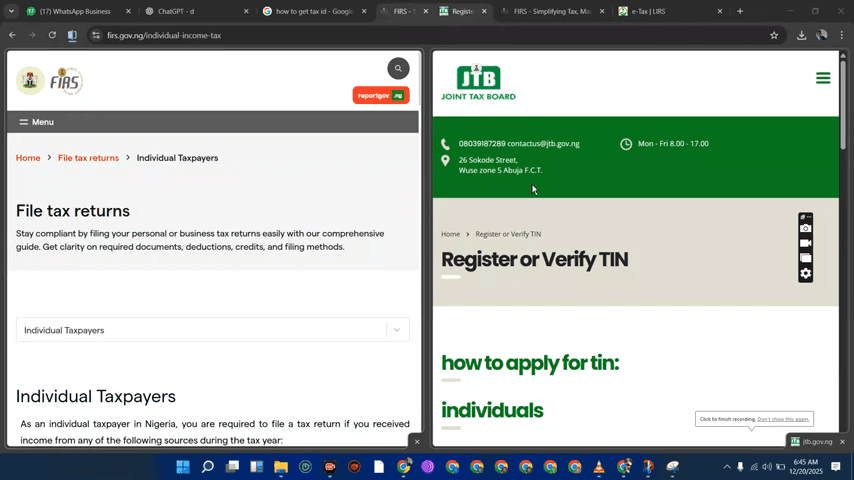
For official references, see FIRS, CAC, and Joint Tax Board (JTB).
What a TIN Actually Represents (Beyond the Definition)
A Tax Identification Number is:
- a unique identifier assigned by tax authorities
- used to track all tax-related activities
However, its real function goes beyond identification.
Expert Insight:
A TIN is not just a number—it is a data anchor that connects your business or personal identity to the tax system.
Every:
- filing
- payment
- compliance record
is tied to your TIN.
Critical Implication:
If your TIN setup is incorrect or incomplete:
- your entire compliance profile becomes unreliable
Who Needs a TIN in Nigeria?
A TIN is required for:
1. Businesses
- registered companies
- business name owners
- SMEs and startups
2. Individuals
- employees
- freelancers
- self-employed professionals
3. Financial Activities
TIN is often required for:
- opening business bank accounts
- accessing loans or funding
- participating in government contracts
Hidden Insight:
Even individuals earning informally are increasingly expected to have TINs as financial systems become more integrated.
How TIN Is Issued in Nigeria (Two Main Pathways)
There are two primary ways to obtain a TIN.
Pathway 1: Automatic TIN via CAC Registration (Companies)
For registered companies:
- TIN is often generated automatically after CAC incorporation
What Most People Miss:
Automatic generation does NOT guarantee:
- active tax profile
- proper registration with tax authorities
Risk:
You may have a TIN that:
- exists in the system
but
- is not fully operational
Pathway 2: Direct Registration with Tax Authorities
Individuals and some businesses must apply directly.
Process Includes:
- submitting identification details
- providing business or employment information
- registering with relevant tax authority
Key Authorities:
- Federal Inland Revenue Service (FIRS)
- State Internal Revenue Services (for personal income tax)
Step-by-Step: How to Get a TIN (Full Process)
Step 1: Determine Your Category
Before applying, identify whether you are:
- a company
- a business owner (sole proprietor)
- an individual
Why This Matters:
Different categories follow different registration paths.
Step 2: Gather Required Information
You will typically need:
For Businesses:
- CAC registration certificate
- company details
- business address
For Individuals:
- valid identification
- employment or income details
- residential address
Defensibility Insight:
All submitted information must be:
- accurate
- consistent across records
Step 3: Register with the Appropriate Authority
Companies:
- confirm TIN issuance via CAC integration
- register with FIRS for full activation
Individuals:
- apply through state tax authority
- provide required documentation
Step 4: Verify Your TIN Status
This is one of the most overlooked steps.
You must confirm:
- your TIN exists
- it is active
- it is correctly linked to your details
Why This Matters:
Inactive or incorrect TINs lead to:
- failed filings
- compliance issues
- audit complications
Step 5: Link Your TIN to All Financial Activities
Your TIN should be used consistently across:
- tax filings
- bank accounts
- financial records
Key Rule:
One identity = one consistent TIN usage
Once your TIN is active, use the CIT filing guide to align submission workflow.
What Most Guides Do Not Tell You
1. Having a TIN Does Not Mean You Are Compliant
You must still:
- file returns
- maintain records
- meet obligations
2. Duplicate TINs Can Create Serious Problems
Some individuals unknowingly obtain:
- multiple TINs
Impact:
- data inconsistency
- compliance confusion
- audit risk
3. TIN Errors Affect Long-Term Records
Incorrect details at registration stage can:
- affect all future filings
- require complex corrections
4. Inactive TINs Are Common
Many businesses:
- have TINs
- but are not actively registered for all taxes
Advanced Insight: TIN as a Compliance Anchor
From a system perspective:
- your TIN is the foundation of your compliance profile
Authorities use it to track:
- filing patterns
- payment behavior
- consistency over time
Critical Point:
Your compliance history is built around your TIN—not your name.
Common Mistakes When Getting a TIN
1. Assuming CAC Registration Is Enough
This leads to incomplete tax setup.
2. Not Verifying TIN Status
Many businesses operate with inactive TINs.
3. Providing Inconsistent Information
Differences between:
- CAC records
- bank details
- tax filings
create problems.
4. Ignoring Individual TIN Requirements
Freelancers often fail to register personally.
Real-World Scenarios
Scenario 1: Fully Integrated Business
- CAC registered
- TIN active
- properly linked to FIRS
Outcome:
- smooth compliance
- low audit risk
Scenario 2: Partial Setup
- has TIN
- not linked to full tax registration
Outcome:
- hidden compliance exposure
Scenario 3: Duplicate TIN Case
- multiple registrations
- inconsistent data
Outcome:
- filing issues
- audit complications
Decision Framework: Is Your TIN Setup Correct?
Ask:
- Do I have a confirmed TIN?
- Is it active and linked properly?
- Are my details consistent across systems?
- Am I using it for all tax-related activities?
If any answer is uncertain:
Your TIN setup is incomplete.
Frequently Asked Advanced Questions
Is TIN mandatory in Nigeria?
Yes, for both businesses and individuals involved in taxable activities.
Can I have more than one TIN?
No. Multiple TINs create compliance issues.
How long does it take to get a TIN?
It depends on the method, but delays often occur due to incomplete documentation.
Does TIN expire?
No, but it must remain active and correctly maintained.
Can I correct errors in my TIN?
Yes, but corrections must be handled carefully and consistently.
Final Perspective
A TIN is not just a requirement—it is the foundation of your tax identity.
Getting it right ensures:
- accurate compliance
- smooth financial operations
- reduced audit risk
Getting it wrong creates:
- long-term complications
- inconsistent records
- potential penalties
Next Step: Move From Registration to Compliance
Once your TIN is properly set up, the next step is ensuring:
- accurate filings
- consistent reporting
- proper documentation
Without this, a TIN becomes a formality—not a system.
For practical controls, use Nigeria SME Tax Compliance Checklist.
Conclusion
Obtaining a Tax Identification Number in Nigeria is a critical step for any business or individual engaging in financial activity.
However, the real value lies not in having a TIN, but in:
- how it is set up
- how it is used
- how it supports your compliance system
By approaching TIN registration strategically, you create a foundation that supports:
- legal operation
- tax efficiency
- long-term sustainability
And in a system where data consistency determines outcomes, that foundation is essential.
TIN Integrity Addendum: One Entity, One Identity Trail
Most downstream tax problems from TIN setup come from identity mismatch:
- spelling differences across CAC and bank KYC
- multiple addresses with no update trail
- duplicate records opened across jurisdictions
Run a quarterly TIN hygiene check with three documents: incorporation record, bank profile, and latest filing acknowledgment.
Source Anchors
Then connect this guide to How to Register a Business for Tax in Nigeria so your setup and usage remain aligned.
Continue reading
Explore other implementation notes in the blog or return to the tool suite.